How to compress a PDF to 100KB, 200KB, or 500KB
Pick the right PDF size target, reduce the file without hiding quality loss, and verify a 100KB, 200KB, or 500KB result before uploading it.
Updated . How guides are checked
Primary sources checked
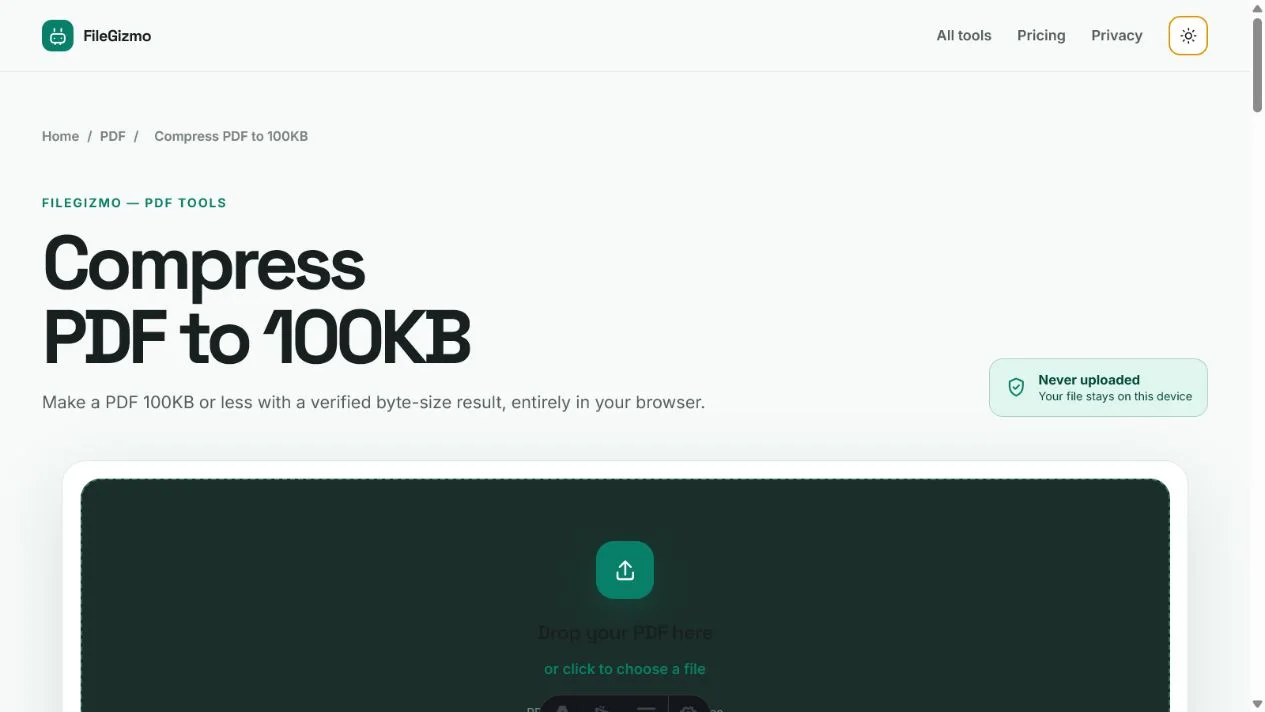
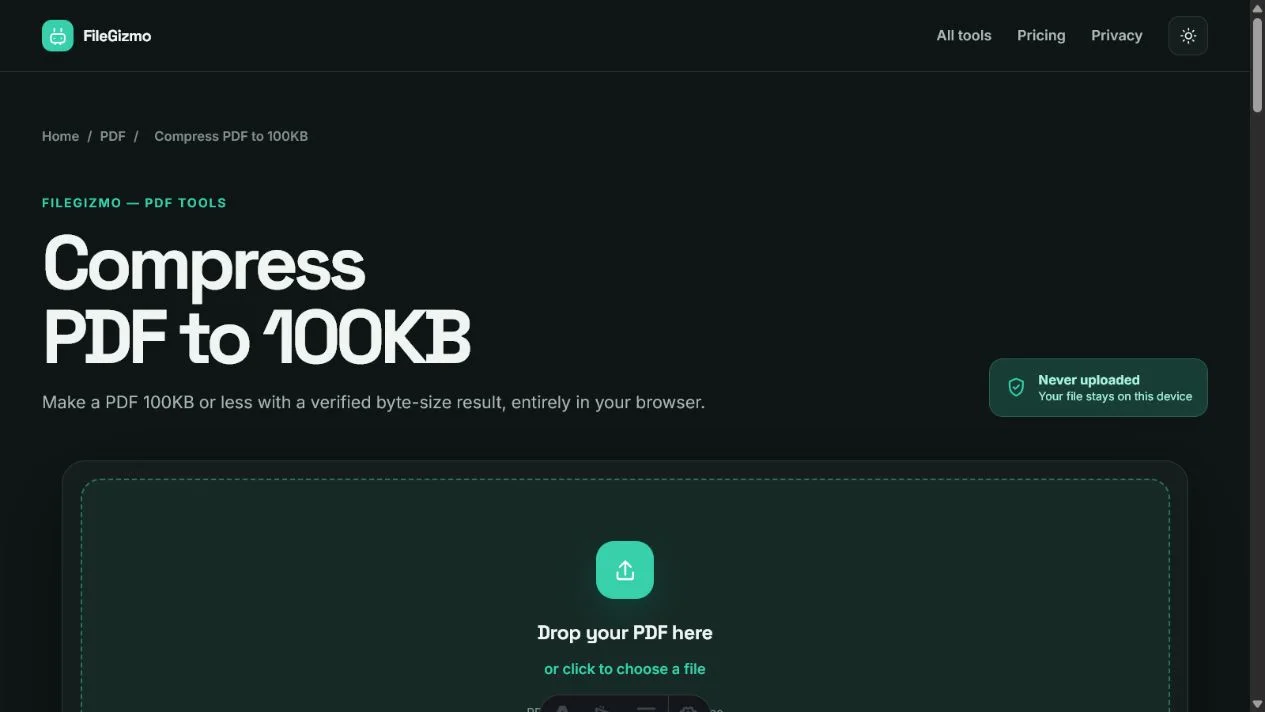
Confirm the portal's real byte limit, keep the original, and choose the matching 100KB, 200KB, or 500KB preset. FileGizmo compresses and verifies the copy in your browser. Exact targets recompress the embedded images, so inspect every name, seal, QR code, and signature before uploading.
The fastest way
Start with the limit shown on the upload field, not a number copied from an old tutorial. A portal may ask for 100KB, 200KB, or 500KB, and a newer notice can change that ceiling. The smallest possible PDF is not the goal. The smallest readable PDF that satisfies the current field is.
If your PDF is already below the limit, upload it unchanged. If it is only slightly over, try standard PDF compression first because that can repack the file without turning text into pixels. Use an exact target only when the portal rejects the standard result or clearly states a strict maximum.
Keep the untouched source beside the compressed copy. Exact-target compression is a delivery step, not an archival strategy.
Pick 100KB, 200KB, or 500KB
Each target creates a different quality budget. The table is a practical starting point, not a promise that every document will fit.
| Target | Verified ceiling | Best starting use | Main risk |
|---|---|---|---|
| 100KB | 102,400 bytes | One short certificate or simple form | Small text and seals can soften quickly |
| 200KB | 204,800 bytes | A short application document or a few clean pages | Fine handwriting and QR codes need close review |
| 500KB | 512,000 bytes | Several pages or colour evidence with moderate detail | Photo-heavy scans may still need more space |
A text-first PDF generated by Word can be smaller than a single photographed certificate. The difference is the content. Vector text and lines store efficiently. A scan usually contains a large raster image for every page, so image resolution and JPEG quality control most of the bytes.
The dedicated 100KB, 200KB, and 500KB routes apply the selected ceiling and report the finished size. They do not merely display a rounded label.
Compress the PDF step by step
- Read the active portal instruction and record the maximum file size, accepted format, colour rule, and page requirement.
- Save an untouched copy of the original PDF.
- Open the matching FileGizmo target tool and choose the PDF from your device.
- Run the compression. The browser tests a practical combination of page scale and image quality, then measures the rebuilt file.
- Download the result only after the tool confirms it is at or below the selected ceiling.
- Open the download in a separate PDF reader and inspect every page.
- Check the exact byte count in file properties, then confirm the portal preview before submitting.
Leave a little margin when another system reports decimal kilobytes. FileGizmo uses binary ceilings, so 100KB means no more than 102,400 bytes. A portal can apply a different convention or add its own validation. A result well below the limit avoids a last-byte rejection.
What exact-target compression changes
Adobe’s current PDF Optimizer documentation lists the usual sources of savings: downsampled images, image compression, font changes, discarded objects, removed user data, and structural cleanup. FileGizmo’s exact-target workflow takes a deliberately narrower route. It re-encodes only the embedded images, adjusts their scale and JPEG quality, and rebuilds the PDF until the copy fits.
That method is predictable, and its consequences are narrower than they sound. Only the embedded images are recompressed, so photographs and scans lose detail while selectable text stays selectable. Interactive fields, links, comments, layers, and attachments all survive as active PDF features. A certificate-backed signature does not, because the document was rewritten.
Use the target copy for a portal that accepts a recompressed document, and keep the original for records. If the recipient needs signature validation, ask whether a larger file or another submission route is available.
Why some PDFs refuse to fit
A 30-page colour scan cannot always become a readable 100KB PDF. The tool has to divide a tiny byte budget across every page. At some point, letters blur together, photographs block up, and QR modules lose their clean edges. A responsible compressor stops before that point instead of producing a technically small but practically useless document.
You can improve the source before another attempt:
- Remove only pages the portal does not require.
- Crop empty scanner borders and desk background.
- Rotate pages before compression.
- Rescan text pages in grayscale only when colour is not evidence.
- Start from the original scan instead of a screenshot of a screenshot.
- Split unrelated documents when the portal provides separate fields.
Do not rename .pdf to .jpg or delete pages that prove identity, category, ownership, or completion. A validator may accept the bytes while a human reviewer rejects the content.
Email is a different size problem
Google currently documents a 25MB attachment limit for personal Gmail accounts. That is far above 100KB, 200KB, or 500KB. If a PDF is too large for email, the right answer may be moderate compression or a controlled sharing link rather than forcing an entire report into a portal-sized copy.
Read why a compressed scan behaves differently from a digital PDF before forcing a long document into a tiny budget. If several PDFs must become one submission, merge them privately before the final compression pass. For broader editing choices, the free PDF editor comparison explains which tools preserve structure and which ones rewrite the file.
Final checks before upload
Open every page at 100 percent and at 200 percent zoom. Read the smallest line. Inspect names, dates, registration numbers, signatures, seals, photographs, barcodes, and QR codes. Confirm page order and orientation. Make sure the downloaded filename ends in .pdf and that your device did not add (1) to an older unverified copy.
Then upload the file and inspect the portal’s own preview. A green size check proves only that the bytes fit. It does not prove that the document is complete, legible, current, or acceptable to the reviewer.
Tools for this guide
Frequently asked questions
How do I compress a PDF to exactly 100KB?
Use the 100KB preset, then check the reported byte count. The tool aims at or below 102,400 bytes rather than promising an exact number. A complex document may need more space to remain readable, in which case the tool reports a clear failure instead of producing an unreadable file.
Does compressing a PDF to 200KB reduce quality?
It can. Lossless structural compression may preserve the page perfectly, but a strict 200KB target often requires lower image resolution or JPEG quality. Review small text, stamps, photographs, signatures, and QR codes at normal size and while zoomed in.
Is 500KB enough for a multi-page PDF?
Often, but not always. A few clean text pages can fit comfortably, while colour scans, photographs, maps, and detailed certificates need more bytes. Page count alone does not predict the result because image detail usually dominates the file size.
Can I reduce a PDF without uploading it?
Yes. FileGizmo performs the compression and byte verification inside your browser. The PDF is not sent to a processing server. You can open the browser Network panel while the tool runs to verify that no request carries the file.